
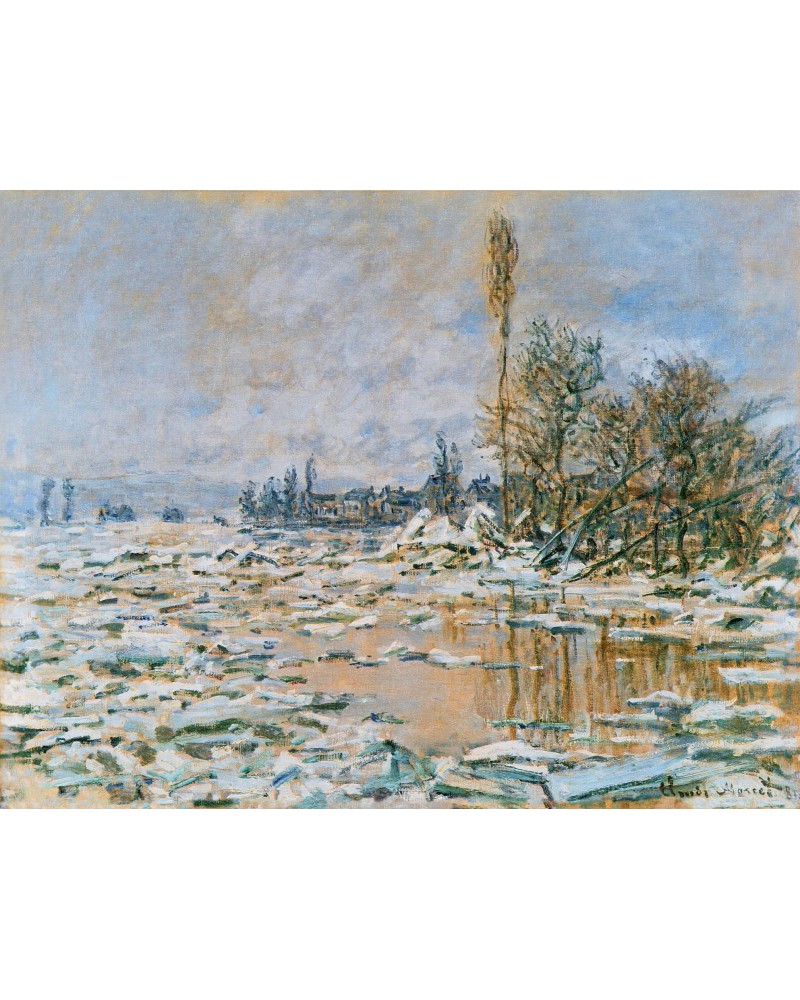
Breakup of Ice, Lavacourt, Grey Weather (1880) by Claude Monet
- Write a review
Claude Monet’s “Breakup of Ice, Lavacourt, Grey Weather” (1880) captures the serene yet desolate beauty of a winter landscape along the Seine River in Lavacourt, a village near his home in Vétheuil. Painted during a particularly harsh winter, the work reflects Monet’s fascination with natural phenomena and their atmospheric effects. The painting exemplifies his Impressionist style, using loose brushstrokes and a subdued color palette to convey the chill and stillness of the scene.
The painting depicts chunks of broken ice floating on the river, surrounded by a muted, overcast sky that merges seamlessly with the cold water. Monet’s use of soft grays, whites, and blues enhances the melancholic tone, while subtle touches of light create a delicate shimmer on the icy surface. The fragmented ice symbolizes nature’s quiet transformation, contrasting with the static calm of the village in the background. This work is a testament to Monet’s ability to capture fleeting moments and the interplay between light, weather, and water. It evokes both the starkness and beauty of winter, immersing viewers in the fragile and transient essence of the season.
- Weight
- 0.3 g
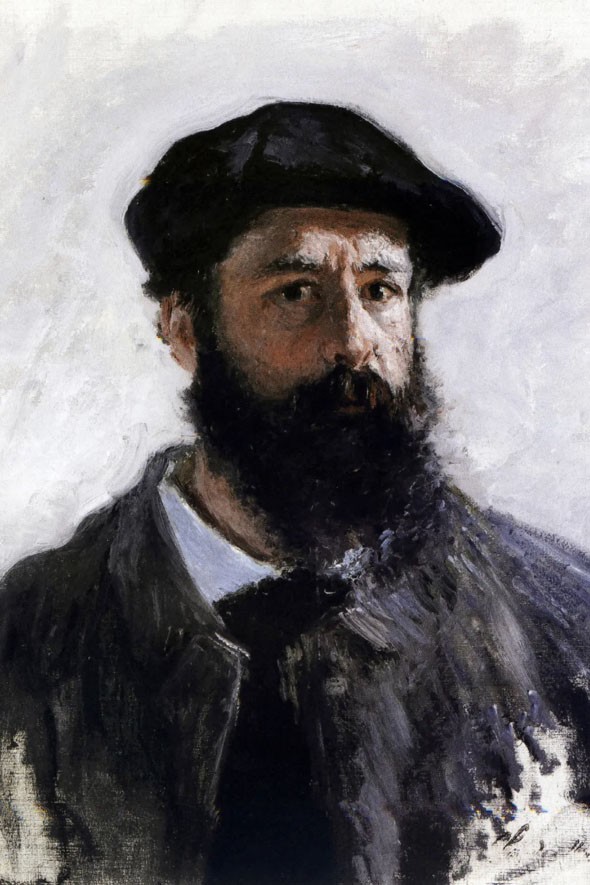
Claude Monet (1840–1926) was a French painter and a pioneering figure of the Impressionist movement, which sought to capture the transient effects of light, atmosphere, and emotion through innovative artistic techniques. Born in Paris and raised in Le Havre, Monet developed an early passion for art, beginning as a caricaturist before studying under landscape painters like Eugène Boudin, who introduced him to painting outdoors (en plein air).
Monet’s work emphasized immediacy and perception, focusing on natural settings and daily life. He used loose brushstrokes, vibrant color palettes, and the interplay of light and shadow to convey the essence of a scene rather than its precise details. His painting Impression, Sunrise (1872) inspired the term “Impressionism.”
Monet often painted the same subject repeatedly, capturing different times of day, weather, and seasons, as seen in his Haystacks, Rouen Cathedral, and Water Lilies series. His garden in Giverny, especially its pond and Japanese bridge, became an iconic subject of his later works.
Monet’s art marked a departure from traditional techniques, influencing generations of artists. His ability to capture ephemeral beauty cemented his legacy as one of the greatest and most beloved painters in history.
详细信息
- Composition
- Symmetry
- Subject
- Still Life
Claude Monet’s “Breakup of Ice, Lavacourt, Grey Weather” (1880) captures the serene yet desolate beauty of a winter landscape along the Seine River in Lavacourt, a village near his home in Vétheuil. Painted during a particularly harsh winter, the work reflects Monet’s fascination with natural phenomena and their atmospheric effects. The painting exemplifies his Impressionist style, using loose brushstrokes and a subdued color palette to convey the chill and stillness of the scene.